


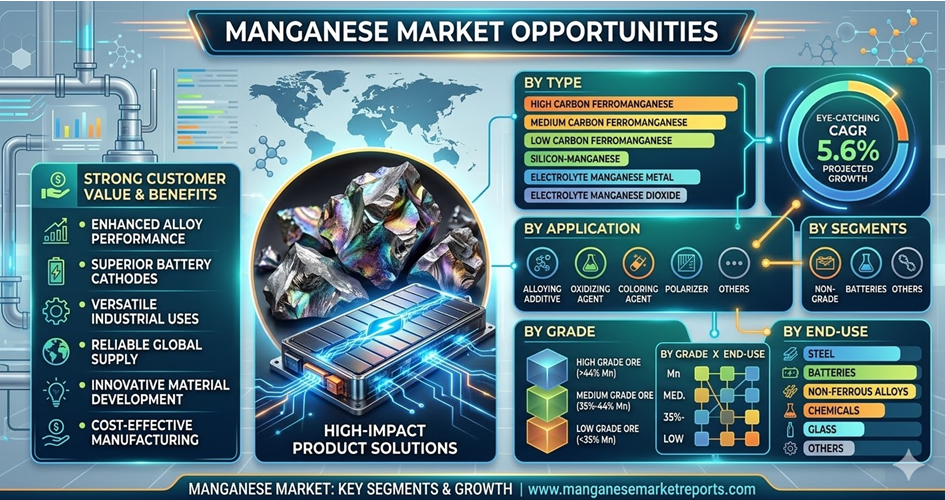
According to a comprehensive analysis by Market Research Future, the global Manganese Market was valued at USD 9,792.09 million in 2024 and is projected to grow from USD 10,456.97 million in 2025 to USD 18,007.78 million by 2035, at a compound annual growth rate (CAGR) of 5.6% over the forecast period. This near-doubling of market value over a decade reflects the powerful dual momentum of a steel industry undergoing its most consequential green transformation in over a century, and a battery technology landscape where manganese-rich chemistries are being recognized as the most economically viable path to mass-market electric mobility.
What Is Manganese and Why Is It Indispensable?
Manganese is the 12th most abundant element in the Earth’s crust and the fifth most abundant metal, yet its combination of properties makes it irreplaceable in applications spanning a vast range of industrial, chemical, and emerging energy domains. As a transition metal, manganese can exist in multiple oxidation states — from +2 through +7 — enabling it to participate in an exceptionally wide range of chemical reactions and material interactions, from metallurgical alloying to catalytic oxidation to electrochemical energy storage.
In steelmaking, manganese plays three distinct and non-substitutable roles simultaneously. As a deoxidizer, it reacts with dissolved oxygen in molten steel during the refining process, preventing the formation of oxide inclusions that would compromise the final product’s mechanical properties. As a desulfurizer, it reacts preferentially with sulfur to form manganese sulfide, which is far less damaging to steel’s hot workability than iron sulfide — a phenomenon known as preventing “hot shortness” that was historically responsible for steel fractures during rolling and forming. And as an alloying element, manganese strengthens steel by solid solution hardening and by promoting the formation of austenitic microstructures that offer exceptional combinations of strength and ductility. These three roles are so fundamental to steelmaking that virtually every grade of steel produced anywhere in the world — from rebar reinforcing concrete to ultra-high-strength automotive steel to stainless — contains manganese. Approximately 85–90% of all manganese produced globally flows directly into steel production as ferromanganese, silicomanganese, or other alloying grades, establishing steelmaking as the unshakeable demand foundation of the entire manganese market.
Beyond steel, manganese finds application as a coloring agent in glass, ceramics, and pigments; as an oxidizing agent in water treatment (potassium permanganate) and chemical synthesis; as a micronutrient fertilizer in agriculture; as a depolarizer in dry cell batteries; and — most consequentially for the market’s future growth trajectory — as an active cathode material in lithium-ion and emerging next-generation battery chemistries for electric vehicles and stationary energy storage.
Get An Exclusive Sample of the Research Report: https://www.marketresearchfuture.com/sample_request/7724
Key Market Drivers Propelling Growth to 2035
Steel Production and Green Steel Transformation: Global crude steel production reached 1,884.6 million tonnes in 2024, and despite cyclical fluctuations driven by economic conditions, construction activity, and energy costs, the structural demand for steel remains extraordinarily robust. Every tonne of steel produced consumes approximately 6–9 kg of manganese in various alloy forms, making the correlation between steel output and manganese consumption tight and predictable. The most consequential development reshaping this demand relationship is the global steel industry’s accelerating transition from carbon-intensive blast furnace–basic oxygen furnace (BF-BOF) production routes toward electric arc furnace (EAF) and direct reduction ironmaking (DRI) routes that dramatically reduce carbon emissions. The traditional BF-BOF steelmaking route emits approximately 2.66 tonnes of CO₂ per tonne of steel produced, compared to 0.71 tonnes for scrap-EAF and 1.66 tonnes for DRI-EAF. As the industry pursues decarbonization under increasingly stringent regulatory frameworks and corporate sustainability commitments, EAF-based production — which melts scrap and DRI using electricity — is rapidly gaining capacity share, particularly in India, the United States, Türkiye, and across Europe. This transition paradoxically increases rather than decreases manganese intensity, because EAF steelmaking with variable scrap inputs requires greater manganese additions to control chemistry, compensate for impurity profiles, and achieve target mechanical properties in finished steel grades. The shift toward high-manganese steels — which offer enhanced strength and ductility at reduced carbon content, supporting lightweighting in automotive and structural applications while maintaining performance standards — further reinforces manganese’s centrality to next-generation steelmaking. In hydrogen-based DRI, where near-zero-emission production is achievable, manganese is indispensable as a deoxidizer and alloying addition in the subsequent EAF melting step. The green steel transition does not diminish manganese demand; it deepens it.
The Electric Vehicle Revolution and Battery-Grade Manganese: The most transformative new demand driver emerging for manganese is its expanding role in lithium-ion battery cathode materials for electric vehicles and grid-scale energy storage. Global EV sales surpassed 15 million units in 2024, with China alone accounting for more than 11 million units across battery electric vehicles (BEVs) and plug-in hybrid electric vehicles (PHEVs). This extraordinary sales velocity is generating an equally extraordinary demand signal for battery-grade manganese, specifically in the form of high-purity manganese sulfate (HPMSM) used in cathode active material production. According to data from Adamas Intelligence, global manganese deployed in EV batteries reached 19,131 tonnes in Q3 2023, representing a 30% year-on-year increase, and 7,048 tonnes in November 2023 alone — a 23% year-on-year rise. Total manganese deployment in EV batteries continues rising sharply on the strength of growing EV production volumes, even as the average manganese content per battery declines with the spread of LFP (lithium iron phosphate) chemistry, which contains no manganese.
The critical battleground for manganese in batteries is the emerging class of lithium-manganese-iron-phosphate (LMFP) cathodes, which achieve higher energy density than standard LFP by incorporating manganese into the olivine crystal structure. LMFP cathodes can require approximately 50–60 kg of manganese per vehicle in their active cathode material (as estimated by SFA Oxford), making LMFP-powered EVs dramatically more manganese-intensive than NMC or LFP vehicles. LMFP is positioned as the most promising chemistry for the mass-market EV segment — offering LFP-level cobalt-free affordability and safety with meaningfully improved energy density that extends vehicle range — making it a potential volume driver of enormous significance for the manganese market through the 2030s. The average manganese per BEV battery stood at approximately 4.2 kg in early 2025, but as LMFP adoption scales, this figure could increase dramatically. Manganese also contributes stabilizing properties to NMC cathodes (nickel-manganese-cobalt), where it improves thermal stability, extends cycle life, and reduces reliance on costly and geopolitically concentrated cobalt — motivating battery manufacturers to increase manganese ratios in their NMC formulations. High-manganese NMx chemistries are emerging as a strategic direction that leverages manganese’s relative abundance and lower cost to improve EV battery economics at scale.
Buy this Premium Research Report at: https://www.marketresearchfuture.com/checkout?currency=one_user-USD&report_id=7724
Green Steel and Decarbonization as a Manganese Demand Amplifier: The steel industry’s decarbonization pathway is not merely a backdrop to manganese demand growth — it is an active amplifier. As the world’s steel producers invest in EAF capacity, green hydrogen-based DRI, and low-carbon alloy development, the metallurgical requirements of new production routes create growing demand for high-quality manganese alloys. New high-manganese steel grades — including Hadfield austenitic manganese steels (containing 10–15% manganese) used in rail crossings, mining equipment, and crusher liners, and advanced high-strength steels (AHSS) for automotive lightweighting containing elevated manganese — represent the product development frontier where material performance innovation and decarbonization objectives converge. Every tonne of CO₂ avoided through green steel production while maintaining mechanical performance targets is to some degree enabled by manganese’s metallurgical contributions, positioning it as one of the enabling minerals of the industrial decarbonization agenda.
Mining Expansion, Resource Security, and Supply Chain Diversification: Manganese ore deposits are more geographically distributed than many critical minerals — South Africa, Australia, Gabon, Brazil, and Ghana host the world’s largest economically viable reserves — but the processing of ore into ferroalloys and high-purity refined products is more concentrated, particularly in China, which dominates electrolytic manganese metal (EMM) and electrolytic manganese dioxide (EMD) production. This processing concentration is increasingly seen as a supply chain vulnerability by battery manufacturers, steelmakers, and governments pursuing critical mineral security strategies. The result is a growing wave of investment in manganese processing capacity outside China — in Europe, Australia, the United States, and South Africa — with particular focus on high-purity manganese sulfate (HPMSM) production capability for battery supply chains. Eramet’s 2025 advancement of HPMSM pilot-scale production with EV battery manufacturer partnerships, South32’s sustainability upgrade at its Australian Manganese operations integrating renewable energy, and OM Holdings’ expansion of alloy capacity in Malaysia are all manifestations of this supply chain diversification and value-chain upgrading trend.
Market Segmentation Insights
By Type — High Carbon Ferromanganese Leads, Silico-Manganese Grows Fastest: High carbon ferromanganese (HC FeMn), containing approximately 74–82% manganese and 6–8% carbon, is the dominant manganese product type by market share, reflecting its central role as the primary deoxidizer and desulfurizer added to steel during basic oxygen furnace and electric arc furnace steelmaking. Its dominance is anchored by the sheer volume of global steel production consuming it at every major steel mill worldwide. Silico-manganese (SiMn), which combines manganese and silicon in a single alloy (typically 65–68% Mn, 16–21% Si), is the fastest-growing type, driven by its dual deoxidizing and alloying function that makes it cost-efficient for steel producers seeking both manganese and silicon additions simultaneously. SiMn’s growth reflects the expansion of EAF steelmaking — where it is particularly valued — and the shift toward low-emission steel routes where its multi-function alloying efficiency delivers additional process advantages.
By Application — Alloying Additive Dominates, Coloring Agent Grows Fastest: The alloying additive application category commands the largest market share by a considerable margin, anchored entirely in steel production’s structural demand for ferromanganese and silicomanganese. The coloring agent application — where manganese compounds including manganese dioxide and manganese permanganate provide purple, brown, and black colorations to glass, ceramics, bricks, roofing tiles, and specialty pigments — is identified as the fastest-growing application, driven by expanding construction activity, architectural materials diversification, and growing demand for aesthetically differentiated industrial materials across emerging market economies. The oxidizing agent application, dominated by potassium permanganate in water treatment and chemical synthesis, and the polarizer application in alkaline and zinc-carbon primary batteries, contribute stable secondary demand streams.
By End-Use Industry — Steel Dominates, Batteries Grow Fastest: Steel is the overwhelming dominant end-use industry for manganese, accounting for 85–90% of global consumption through ferroalloy applications, reflecting the metal’s structural centrality to global steelmaking. The batteries end-use segment is identified as the fastest-growing end-use category in the entire manganese market — a designation that reflects not just the impressive percentage growth rates of battery-grade manganese consumption from a lower base, but the extraordinary structural significance of the EV and energy storage transitions in reshaping manganese’s demand profile over the forecast horizon. As global EV production scales from tens of millions to potentially hundreds of millions of units annually through the 2030s and 2040s, the batteries end-use segment is positioned to grow from its current modest share of overall manganese consumption into a genuinely major demand vector that meaningfully diversifies the market’s demand structure away from its steel-concentrated base.
By Grade — High Grade Leads, Medium Grade Transitions: High-grade manganese ore (above 44% Mn content) commands the premium pricing and specification requirements of the most demanding applications in steel production and particularly in refined product manufacturing for batteries. South Africa’s Kalahari basin hosts some of the world’s highest-grade manganese deposits, contributing substantially to global high-grade supply. Medium-grade ore (35–44% Mn) serves the bulk of ferroalloy production requirements, while low-grade ore (below 35% Mn) finds applications in cement production, agriculture, and lower-specification industrial uses.
Regional Market Insights
Asia-Pacific is both the largest and fastest-growing regional market, accounting for approximately 40% of global manganese consumption. China is the world’s dominant manganese consuming and processing nation, with its massive steel industry — producing over 1 billion tonnes of crude steel annually — generating enormous ferroalloy demand, while its leading EV manufacturing industry is driving rapidly growing HPMSM demand for battery cathode production. India is emerging as a critical secondary growth engine, with steel production expanding rapidly under infrastructure investment programs and a growing domestic EV industry beginning to generate battery-grade manganese demand. Japan and South Korea contribute significant value-added manganese consumption through specialty steel and battery manufacturing, while Australia plays a critical dual role as both a major ore-producing nation (through South32’s GEMCO operation, one of the world’s largest manganese mines) and a growing HPMSM processing investment target.
North America accounts for approximately 26% of global market share, characterized by a mature industrial base with strong steel and automotive manufacturing sectors and an accelerating clean energy transition creating new battery-grade manganese demand. The United States is the largest national market, with growing domestic investment in HPMSM processing capacity driven by the Inflation Reduction Act’s incentives for North American battery supply chain development. Canada contributes through both mining activity and battery material processing investment.
Europe holds approximately 20% of global market share, shaped by the world’s most demanding carbon border adjustment mechanism and green steel investment programs. Germany, France, and the UK lead regional manganese consumption through automotive steel manufacturing and growing battery gigafactory buildout. Eramet’s HPMSM production qualification for European battery manufacturers exemplifies the continent’s strategy of building integrated manganese processing capabilities within domestic borders to serve the surging EV supply chain.
Middle East and Africa accounts for approximately 12% of global market share but holds disproportionate strategic importance as the source of much of the world’s highest-quality manganese ore. South Africa — home to the Kalahari Manganese Field, the world’s single largest manganese ore deposit — is a globally critical supplier, with producers including Assmang, United Manganese of Kalahari, and Tshipi é Ntle Manganese Mining playing pivotal roles in global supply. The region’s infrastructure investment programs, particularly in Gulf Cooperation Council countries, are generating growing domestic manganese consumption through construction and steel demand.
Competitive Landscape and Key Players
The global manganese industry is moderately concentrated at the mining level, with a small number of large producers dominating ore output, and more fragmented at the ferroalloy and refined product processing levels. Key players include Eramet (France), South32 (Australia), MOIL Limited (India), Jupiter Mines (Australia), OM Holdings Limited (Singapore/Malaysia), United Manganese of Kalahari (South Africa), Assmang (South Africa), Anglo American (UK), LHG Mining (China), and AML Holdings LLC (US/South Africa). China’s EMM and EMD production base — dominated by numerous mid-size processors in Hunan, Guangxi, and Guizhou provinces — represents the world’s largest refined manganese manufacturing complex, producing the high-purity products essential for battery cathode material precursors.
The competitive landscape is being reshaped by three intersecting dynamics: the race to develop HPMSM production capability outside China for battery supply chain security; the drive to integrate sustainability credentials (renewable energy use, responsible mining certification, low-carbon processing) that increasingly determine market access in regulated markets; and the investment in digital mining technologies including AI-enabled geological modeling, automated ore sorting, and process optimization that improve recovery rates and reduce operational costs. In 2025, Eramet’s completion of HPMSM pilot-scale qualification with EV battery manufacturer partnerships marked a significant step toward European battery supply chain independence. South32’s renewable energy integration at its Australian operations and OM Holdings’ energy-efficient furnace installation in Malaysia both reflect the industry’s recognition that sustainability performance is becoming a competitive prerequisite, not merely a regulatory obligation.
Future Outlook and Conclusion
The global Manganese Market is on a compelling trajectory toward USD 18,007.78 million by 2035, advancing at a CAGR of 5.6% powered by the twin engines of an evolving global steel industry and an accelerating clean energy transition that is discovering manganese’s extraordinary versatility as a battery material. The market’s most significant structural evolution over the forecast period will be the rise of the battery segment from a minor demand contributor to a strategically critical end-use that reshapes how the entire industry values, develops, and processes manganese resources. High-purity manganese sulfate production, LMFP cathode commercialization, advanced high-manganese steel grade development, and digital transformation of mining operations represent the four most consequential investment frontiers for market participants. For producers, processors, battery manufacturers, automakers, steel producers, and policymakers navigating the intersection of industrial decarbonization and the critical minerals imperative, manganese’s journey from steel’s indispensable alloying partner to the battery revolution’s emerging cornerstone material defines one of the most compelling resource market stories of the coming decade.
For more insights on Market, visit the Market Research Future page and explore detailed market analysis, forecasts, and company strategies.
Creosote Oil Market
Wind Power Coating Market
Fuel Cell Generator Market
Petroleum Fuel Dyes And Marker Market
Calcined Petroleum Coke Market
Chemical Tanker Shipping Market
Plastic Waste Pyrolysis Oil Market
Acrylamide Tertiary-Butyl Sulfonic Acid (ATBS) Market
Formic Acid Market