


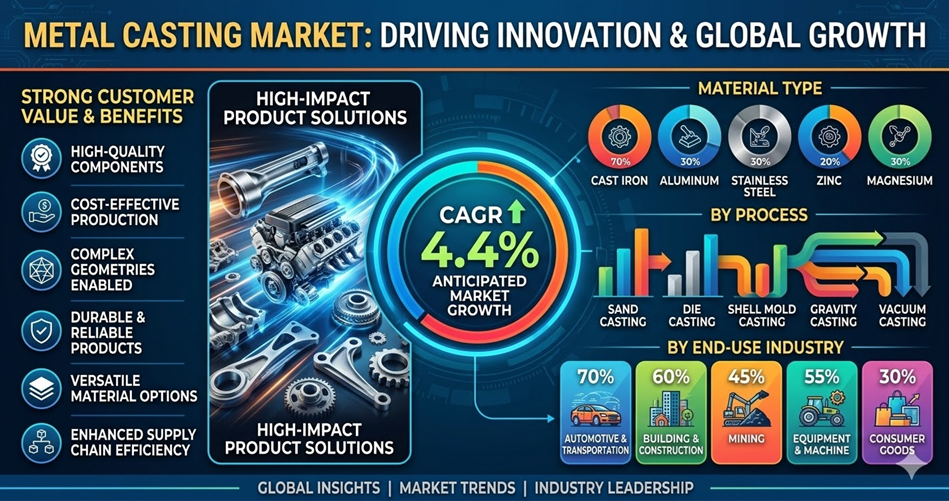
According to a comprehensive analysis by Market Research Future, the global Metal Casting Market was valued at USD 149.8 billion in 2024 and is projected to grow from USD 156.39 billion in 2025 to USD 240.61 billion by 2035, at a compound annual growth rate (CAGR) of 4.4% throughout the forecast period. This steady and compounding expansion of a market already measured in the hundreds of billions reflects the breadth and depth of casting’s indispensability across the world’s most significant industrial sectors — and the accelerating investment of a global industry reinventing itself for the clean energy and digital manufacturing era.
What Is Metal Casting and Why Does It Remain Irreplaceable?
Metal casting is the manufacturing process of producing shaped components by pouring molten metal into a mold cavity, allowing the metal to solidify, and then removing the finished casting from the mold. Despite the apparent simplicity of this description, casting encompasses an extraordinary range of process variants, material options, complexity levels, and production scale — from a single-piece bronze sculpture weighing a few grams to a ship propeller weighing over 100 tonnes, from a high-precision aerospace turbine blade with internal cooling channels to millions of identical aluminum die-cast automotive door handles produced every year at a single facility.
The enduring competitive advantage of casting over alternative metal-forming processes — machining from solid stock, forging, stamping, welding fabrications — lies in its ability to produce shapes of essentially arbitrary geometric complexity, including internal cavities, undercuts, thin walls, and integral functional features, in a single manufacturing step without requiring extensive secondary machining. A cast engine block achieves in one pour what would require dozens of separate machining operations from a billet of solid aluminum or iron. This shape-making efficiency translates directly into lower material waste, shorter production cycles, reduced tooling investment compared to many alternatives for complex geometries, and the ability to consolidate multiple previously separate components into a single integral casting — a “part consolidation” strategy that simultaneously reduces assembly labor, eliminates fasteners and joints, and improves structural integrity. As the automotive, aerospace, and energy sectors push toward lighter, more complex, and more functionally integrated structures, casting’s geometric freedom and material versatility become more rather than less valuable.
The range of materials processable by casting spans virtually every commercially significant metal and alloy: cast iron (gray, ductile, white, and malleable grades) for their excellent castability, damping properties, and wear resistance; aluminum alloys for their lightweight, corrosion resistance, and excellent die casting characteristics; steel for high strength and toughness in demanding structural applications; zinc alloys for thin-wall, high-precision die casting in consumer and electronic hardware; magnesium alloys for the lightest-weight structural castings; copper alloys for electrical and marine applications; nickel superalloys for jet engine and gas turbine components; titanium alloys for aerospace and biomedical precision castings. This material breadth means that virtually every metallic component in every industrial application — from consumer electronics housings to nuclear reactor internals — can be and in most cases is produced by some casting variant.
Get An Exclusive Sample of the Research Report: https://www.marketresearchfuture.com/sample_request/8114
Key Market Drivers Accelerating Growth to 2035
Automotive Sector Transformation and the EV Casting Revolution: The automotive and transportation sector is the single largest end-use industry for metal castings, projected to account for approximately 30% of total market demand by 2025 and valued at USD 45–75 billion through the forecast period. The sector’s relationship with casting is undergoing its most consequential transformation in a century as internal combustion engine powertrains — historically the source of the highest-value, highest-volume engine block and transmission housing castings — give way to electric drivetrains whose casting requirements are fundamentally different in both form and material. EV powertrains require far fewer castings than ICE powertrains (electric motors have far fewer moving parts than combustion engines), but the castings they do require are often structurally more complex and technically more demanding. Battery housing enclosures — large, structurally complex, thermally managed aluminum castings that protect the battery pack from impact, moisture, and thermal excursion — represent an entirely new casting category with stringent dimensional tolerance, pressure-tightness, and structural integrity requirements. Structural body castings — large aluminum “megacastings” that consolidate entire front or rear underbody structures into a single die-cast component — are being adopted by Tesla, Volvo, and other leading automakers as a path to dramatically reduce body assembly complexity and weight simultaneously. Nemak’s inauguration of a new aluminum casting facility in Nuevo León, Mexico in Q2 2024 specifically dedicated to EV structural and battery components, and its Q1 2025 multi-year supply agreement with Tesla for aluminum battery housing castings, illustrates precisely how the industry’s leading automotive casting specialists are repositioning their entire business model around the EV transition.
Aerospace Industry Growth and High-Value Precision Castings: The aerospace industry is identified as a significant and structurally growing driver for metal casting, expected to account for approximately 20% of total market demand by 2025. Aircraft and spacecraft require castings of the highest technical specification — titanium investment castings for structural frames and engine nacelles, nickel superalloy investment castings for turbine blades and vanes operating at temperatures above the melting point of most metals (sustained by internal cooling channels cast directly into the component), aluminum sand and permanent mold castings for structural airframe nodes, and precision steel castings for landing gear and actuation system components. The combination of rising global air travel demand, commercial aircraft order backlogs stretching years into the future at both Airbus and Boeing, and expanding defense aviation procurement globally is generating sustained high-value demand for aerospace precision castings. Arconic’s Q2 2024 acquisition of Cast-Fab Technologies to expand its precision casting capabilities for aerospace and industrial markets, and GF Casting Solutions’ Q1 2025 inauguration of an additive manufacturing R&D center in Germany focused on integrating 3D printing with traditional casting processes for aerospace applications, both reflect the strategic priority the industry assigns to aerospace casting capability development.
Infrastructure Development and Renewable Energy Demand: Global infrastructure investment — in roads, bridges, rail systems, ports, water treatment facilities, power grids, and urban construction — generates enormous and broadly distributed demand for cast metal components. Infrastructure-related demand is estimated to contribute approximately 25% of overall metal casting consumption by 2025, with construction and public works projects requiring cast iron pipe and fittings, structural steel castings, pump and valve housings, and a vast range of other cast components. The renewable energy sector is emerging as a particularly dynamic new demand source, with wind turbine nacelle housings, main bearings, gear housings, and hub castings representing large-format, high-value castings that require specialized foundry capabilities — GE Vernova’s USD 250 million contract to supply large-scale castings for wind turbine components to a major renewable energy project in India in Q3 2024 exemplifies the scale of individual casting contracts that the renewable energy build-out is generating. Solar energy infrastructure, hydropower facilities, and energy storage systems add further casting demand across a renewable energy sector growing at extraordinary rates globally.
Defense Modernization and Strategic Industrial Investment: The global surge in defense spending — driven by geopolitical tensions across Europe, the Indo-Pacific, and the Middle East — is generating growing demand for high-performance metal castings in armored vehicle hulls, artillery systems, naval vessel components, and precision defense electronics housings. Bharat Forge’s Q4 2024 joint venture with Rheinmetall for advanced defense castings including armored vehicle components and artillery systems is one of the most significant recent indicators of defense casting’s growing strategic importance. Defense castings command premium pricing and require the highest technical specifications, making them a value-accretive market segment for foundries with the requisite metallurgical expertise and quality certification infrastructure.
Technological Innovation: Automation, AI, and Additive Manufacturing Integration: The metal casting industry’s technological transformation is proceeding on multiple simultaneous fronts. Automation and robotics are being deployed across pouring, cooling, shakeout, cleaning, and inspection operations, reducing labor dependency, improving consistency, and enabling the round-the-clock operation that capital-intensive foundry equipment demands. AI-driven process monitoring and control — using machine learning algorithms to analyze real-time process sensor data and adjust parameters to maintain casting quality — are reducing defect rates and improving yield in high-volume die casting operations. Simulation software (ProCAST, Magma, Flow-3D) enables engineers to virtually model mold filling and solidification behavior before cutting tooling, dramatically reducing trial-and-error development cycles for new casting designs. Most consequentially, the integration of additive manufacturing (3D printing of sand molds and cores using binder jetting) with traditional sand casting is enabling the production of casting geometries previously impossible to achieve with conventional sand mold construction — internal cooling channels, organic structural lattices, and complex internal passages that dramatically expand casting’s design envelope while reducing lead times for prototype and low-volume production. GF Casting Solutions’ new additive manufacturing R&D center in Germany is focused precisely on exploiting this convergence of 3D printing and casting for next-generation automotive and aerospace components.
Buy this Premium Research Report: https://www.marketresearchfuture.com/checkout?currency=one_user-USD&report_id=8114
Market Segmentation Insights
By Material Type — Cast Iron Leads, Aluminum Grows Fastest: Cast iron — encompassing gray iron, ductile (nodular) iron, and specialty variants — holds the largest market share among material types, reflecting its deep embedding in automotive engine and drivetrain components, machine tool beds, pipe and fittings, agricultural equipment, and heavy industrial applications where its excellent castability, vibration damping, and wear resistance are decisive advantages. Aluminum is firmly established as the fastest-growing material type, projected to reach USD 40–70 billion through the forecast period, driven by the automotive lightweighting imperative (where aluminum’s density advantage over iron and steel directly translates into vehicle fuel economy and EV range), the aerospace sector’s weight-critical design requirements, and the consumer electronics industry’s demand for thin-wall, high-precision die cast housings. Stainless steel castings serve corrosion-critical applications in chemical processing, food manufacturing, and marine environments; zinc provides the precision and economics of high-pressure die casting for small, intricate components; and magnesium — the lightest structural casting metal — is gaining momentum in automotive and aerospace applications where extreme weight reduction justifies its higher cost and more demanding processing requirements.
By Process — Sand Casting Dominates, Die Casting Grows Fastest: Sand casting retains the largest process share, valued at USD 30–50 billion through the forecast period, owing to its extraordinary versatility — it can process virtually any castable metal, accommodate part sizes from kilograms to hundreds of tonnes, and serve both one-off and high-volume production without prohibitive tooling investment. Sand casting’s flexibility makes it the default process for large structural castings (wind turbine hubs, mining equipment frames, ship components), low-to-medium volume specialty castings, and prototype development where mold revision cost must be minimized. Die casting — which forces molten metal under high pressure into precision metal dies at high speed — is the fastest-growing casting process, driven by the automotive industry’s insatiable demand for high-volume, dimensionally precise, thin-wall aluminum and zinc components and by the accelerating adoption of large-format aluminum structural die castings in EV manufacturing. Ryobi Die Casting’s new Kentucky facility expansion and CITIC Dicastal’s USD 200 million aluminum wheel casting plant expansion are both manifestations of die casting capacity investment driven by automotive demand growth. Shell mold casting, gravity (permanent mold) casting, and vacuum casting each serve specialized niches combining superior surface finish, dimensional accuracy, and metallurgical quality requirements that neither sand casting nor conventional die casting can simultaneously achieve.
By End-Use Industry — Automotive Leads, Construction Grows Fastest: Automotive and transportation holds the dominant end-use position, projected at USD 45–75 billion, anchored by the ICE-to-EV transition’s sustained and restructured demand for cast components. Building and construction is identified as the fastest-growing end-use segment, fueled by global infrastructure investment programs, urbanization-driven real estate development, and the construction of renewable energy facilities that each require substantial cast component inputs. Mining, industrial equipment and machinery, and consumer goods round out the major end-use categories, each contributing stable and growing demand streams that diversify the market’s exposure across economic cycles.
Regional Market Dynamics
North America holds the largest regional share at approximately 40%, anchored by the world’s most sophisticated automotive and aerospace manufacturing ecosystems. The United States is the dominant national market, with foundries concentrated in the Midwest’s traditional manufacturing belt and supplemented by newer facilities in the South and Southwest. Alcoa, General Electric, Waupaca Foundry, and Nemak’s North American operations are among the leading producers. The region is experiencing significant investment in aluminum die casting capacity for EV components, with Ryobi Die Casting’s Kentucky expansion and Nemak’s Tesla battery housing contract both reflecting the geographic pull of North American EV production on casting supply chains. Canada contributes through automotive casting supply for the integrated North American vehicle manufacturing network.
Europe accounts for approximately 30% of global market share and is the world’s leader in precision casting technology, sustainable foundry operations, and casting simulation and process innovation. Germany leads European production with one of the world’s most advanced foundry sectors — producing sophisticated automotive, aerospace, and industrial castings — supported by world-class research institutions and a dense ecosystem of equipment, materials, and software suppliers. Italy, France, and the UK are significant secondary markets. The European Union’s Green Deal is accelerating investment in energy-efficient melting and processing technologies, bio-based binder systems (as exemplified by ASK Chemicals’ Q3 2025 eco-friendly binder launch), and recycled metal utilization across European foundries. Thyssenkrupp and BASF are among the leading corporate actors in the regional market’s ongoing technological and sustainability transformation.
Asia-Pacific holds approximately 25% of global market share and is firmly established as the fastest-growing region, with China operating the world’s largest foundry sector by output volume. China’s casting production — dominated by gray and ductile iron for automotive and industrial applications, and rapidly expanding aluminum die casting for EV components — dwarfs that of any other single nation. India is the most dynamic growth market, with its expanding automotive manufacturing industry, massive infrastructure investment programs, and rapidly developing defense manufacturing sector all driving casting demand. Tupy S.A.’s USD 100 million foundry investment in Brazil and GE Vernova’s Indian wind turbine casting contract both reflect the region’s extraordinary investment scale. Japan and South Korea contribute high-value precision casting through Hitachi Metals (which secured a US rail infrastructure casting contract in Q2 2025) and Toyota Tsusho.
Middle East and Africa holds approximately 5% of global market share but is characterized by significant investment momentum, with Gulf Cooperation Council infrastructure programs and South Africa’s established industrial base providing the regional demand foundation. The region’s emerging manufacturing diversification strategies — particularly in Saudi Arabia under Vision 2030 — are creating growing local casting demand that was previously satisfied predominantly through imports.
Competitive Landscape and Key Industry Developments
The global metal casting industry is highly fragmented at the lower end — with tens of thousands of small and medium-sized foundries worldwide serving local and regional markets — and moderately concentrated at the high-value, high-volume upper end, where technical sophistication, capital investment, and customer qualification requirements create meaningful barriers to entry. Alcoa (US), BASF (DE), General Electric (US), Hitachi Metals (JP), Magna International (CA), Nemak (MX), Thyssenkrupp (DE), Toyota Tsusho (JP), and Waupaca Foundry (US) represent the market’s leading corporate participants, each bringing distinct strengths in specific material, process, or application domains.
The period from 2024 to 2025 has been marked by extraordinary strategic activity. Nemak’s new Mexico EV casting facility, Tesla battery housing contract, and EV component strategy repositioning define one of the casting industry’s most decisive pivots from ICE to electric powertrain supply. Arconic’s acquisition of Cast-Fab Technologies extends its precision casting portfolio for aerospace and industrial markets. Tupy S.A.’s USD 100 million Brazilian foundry targets commercial vehicle and off-highway equipment demand. GE Vernova’s USD 250 million wind turbine casting contract signals the renewable energy sector’s emergence as a major casting market. Bharat Forge and Rheinmetall’s defense casting joint venture opens a new high-value market segment in India. GF Casting Solutions’ additive manufacturing R&D center represents the industry’s frontier investment in process innovation. CITIC Dicastal’s USD 200 million aluminum wheel casting expansion reflects China’s continued dominance of high-volume automotive casting. ASK Chemicals’ eco-friendly binder system introduction advances the industry’s sustainability transformation at the consumables level.
Future Outlook and Conclusion
The global Metal Casting Market is advancing confidently toward USD 240.61 billion by 2035, growing at a steady 4.4% CAGR supported by one of the broadest and most structurally diverse demand bases of any industrial materials market. The industry’s transformation is being simultaneously driven by the automotive sector’s EV transition (which restructures rather than reduces casting demand while creating new high-value aluminum and magnesium casting categories), the aerospace sector’s sustained growth in precision casting requirements, the global infrastructure and renewable energy build-out, the defense modernization wave, and the deepening integration of digital manufacturing technologies that are expanding casting’s geometric and performance capabilities while reducing its cost, waste, and environmental footprint. New investment priorities through 2035 include automated casting facilities for EV component production, eco-friendly binder and process chemistry for sustainable foundry operations, additive manufacturing integration for complex geometry and rapid prototype casting, and expansion into emerging market foundry capacity in India, Southeast Asia, and Africa. As the world’s industrial and energy economy continues its structural transformation, metal casting — the oldest mass manufacturing process in human civilization — is proving itself one of the most adaptable, essential, and forward-looking industries of the modern era.
For more insights on Market, visit the Market Research Future page and explore detailed market analysis, forecasts, and company strategies.