


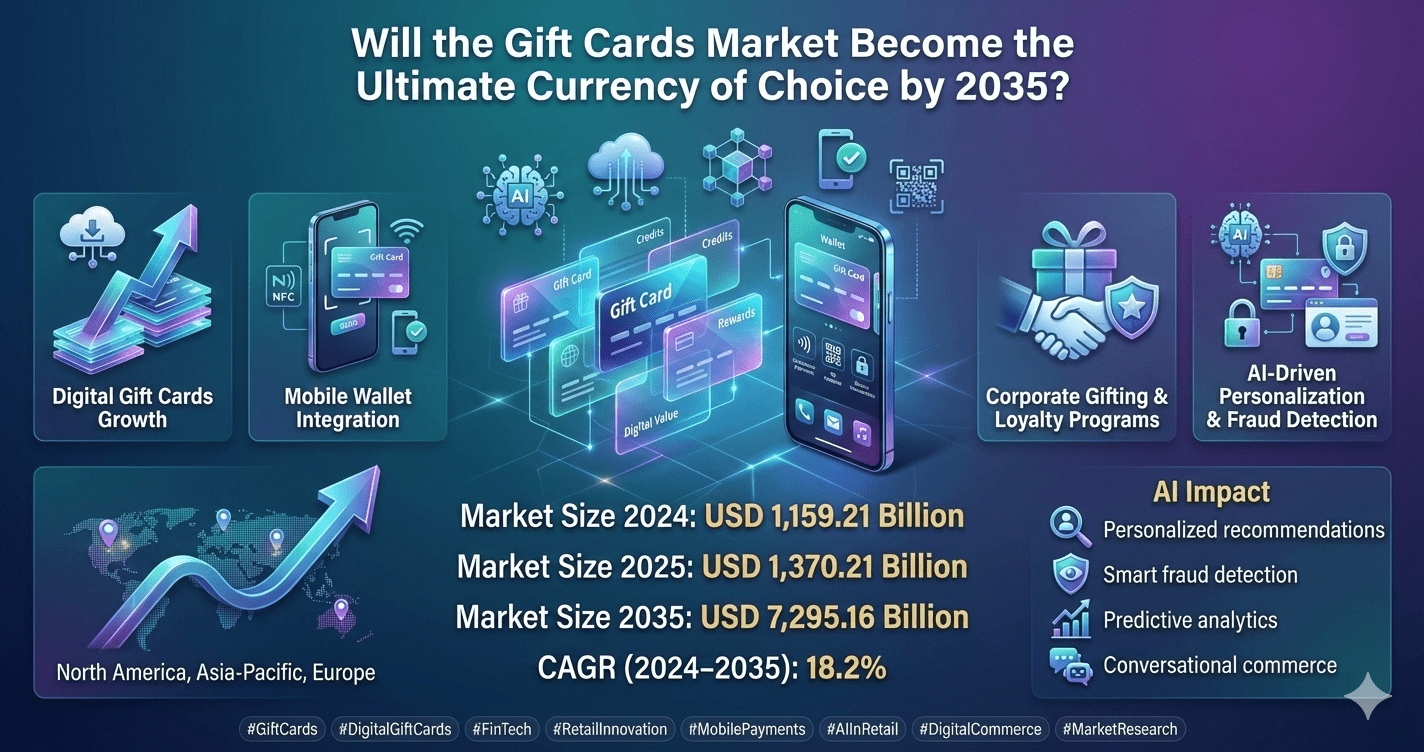
The Gift Cards Market is experiencing unprecedented expansion, reflecting a fundamental shift in consumer spending behavior and digital payment preferences worldwide. Valued at USD 1159.21 billion in 2024, the market has surged to USD 1370.21 billion in 2025, demonstrating robust momentum in just one year. Industry projections indicate this dynamic sector will reach an impressive USD 7295.16 billion by 2035, advancing at a compound annual growth rate of 18.2% throughout the forecast period from 2025 to 2035. This extraordinary growth trajectory positions gift cards as one of the most rapidly evolving segments within the global payments and retail ecosystem.
The competitive landscape features prominent market leaders including Amazon (US), Walmart (US), Target (US), Starbucks (US), Apple (US), Google (US), eBay (US), Best Buy (US), and Macy’s (US). These industry giants have established comprehensive gift card programs that integrate seamlessly with their existing retail operations, creating powerful customer engagement tools while simultaneously driving revenue streams. Amazon and Walmart dominate the general merchandise category with their versatile gift card offerings, while specialty players like Starbucks and Apple have cultivated loyal customer bases through branded gift card ecosystems. The strategic positioning of these key players continues to shape market dynamics, with continuous innovation in digital delivery methods, personalization features, and integration with loyalty programs driving competitive differentiation.
Regional analysis reveals North America maintaining its position as the largest market for gift cards, driven by high consumer awareness, widespread retail adoption, and advanced digital infrastructure. The region’s mature e-commerce environment and established gifting culture contribute significantly to market dominance. Europe follows as the second-largest market, benefiting from increasing digitalization and the growing popularity of corporate gifting programs across enterprises. However, the Asia-Pacific region is emerging as the fastest-growing market, propelled by rapid urbanization, expanding middle-class populations, rising smartphone penetration, and the proliferation of digital payment platforms. Countries including China, India, and Southeast Asian nations are witnessing exponential growth in gift card adoption as e-commerce platforms and retail chains aggressively promote these convenient payment instruments.
Access Free Sample Copy – https://www.marketresearchfuture.com/sample_request/12013
The market segmentation by type encompasses open-loop and closed-loop gift cards, each serving distinct consumer needs and use cases. Open-loop gift cards, typically branded with payment network logos such as Visa or Mastercard, offer recipients flexibility to use them across multiple merchants, functioning similarly to prepaid debit cards. Closed-loop gift cards, conversely, are restricted to specific retailers or restaurant chains, creating brand loyalty and ensuring spending remains within the issuer’s ecosystem. The closed-loop segment currently dominates market share due to retailer preference for customer retention and repeat purchases. Distribution channels have evolved significantly, with digital channels experiencing explosive growth compared to traditional physical retail outlets. The convenience of instant delivery via email or mobile apps, coupled with personalization options and last-minute gifting solutions, has accelerated the digital transition.
End-use segmentation reveals diverse application across retail, restaurant, entertainment, and corporate sectors. The retail segment commands the largest share, encompassing general merchandise, fashion, electronics, and specialty stores. Corporate gifting represents a rapidly expanding segment, with businesses leveraging gift cards for employee rewards, customer incentives, and promotional campaigns. The entertainment category, including streaming services, gaming platforms, and experience-based offerings, has gained substantial traction among younger demographics. Currency type analysis distinguishes between single-currency and multi-currency gift cards, with the latter gaining prominence in the context of globalization and cross-border e-commerce transactions.
The integration of digital wallets and mobile payment solutions represents a pivotal market opportunity, fundamentally transforming how consumers acquire, store, and redeem gift cards. Major technology platforms including Apple Pay, Google Pay, and Samsung Pay now support digital gift card storage, eliminating the risk of physical card loss while enabling seamless redemption at point-of-sale terminals. This technological convergence enhances accessibility and user experience, particularly appealing to tech-savvy millennials and Generation Z consumers who prioritize mobile-first solutions. Retailers are responding by developing proprietary mobile applications with integrated gift card functionality, creating frictionless customer journeys from purchase to redemption.
Access Full Report – https://www.marketresearchfuture.com/reports/gift-cards-market-12013
Key market dynamics center on rising consumer preference for digital gift cards, fundamentally reshaping industry competition and innovation strategies. The COVID-19 pandemic accelerated this transition as consumers sought contactless payment options and digital gifting alternatives during lockdowns and social distancing measures. This behavioral shift has proven persistent, with digital gift cards now accounting for an increasingly dominant share of total market volume. Providers are innovating aggressively, introducing features such as video greetings, customizable designs, scheduled delivery, and integration with social media platforms. The competitive intensity has spurred strategic partnerships between retailers and technology companies, creating comprehensive ecosystems that blur traditional boundaries between physical and digital commerce.
Driving factors propelling market expansion include the growing prevalence of e-commerce platforms, which provide convenient distribution channels for digital gift cards while expanding market reach beyond geographic constraints. Consumer demand for flexible gifting options that accommodate diverse preferences and avoid sizing or style mismatches continues to drive adoption. Additionally, corporate adoption of gift cards for employee rewards and recognition programs has created a substantial B2B market segment. Sustainability trends are influencing product development, with digital gift cards positioned as environmentally friendly alternatives to plastic cards and traditional gift wrapping. Trends shaping the future landscape include blockchain-based gift cards offering enhanced security and transparency, AI-powered personalization recommendations, and subscription-based gift card models providing recurring value delivery.
The escalating Iran vs Israel and USA tensions are creating ripple effects across the Gift Cards Market, particularly impacting international payment processing systems, cross-border e-commerce transactions, and global supply chains for physical gift card production. Geopolitical instability in the Middle East introduces uncertainties in oil prices, which directly affect logistics costs for retailers maintaining physical gift card inventory and distribution networks. Additionally, payment processing infrastructure faces potential disruptions as financial institutions navigate sanctions, compliance requirements, and heightened cybersecurity threats. While digital gift cards remain relatively insulated from physical supply chain disruptions, the broader economic uncertainty stemming from conflict zones influences consumer discretionary spending and corporate gifting budgets, potentially moderating short-term growth rates in affected regions.
GLOBAL SUPPLY CHAIN & MARKET DISRUPTION ALERT
Escalating geopolitical tensions in the Middle East, particularly around the Strait of Hormuz and the Red Sea, are creating significant disruptions across global energy, chemicals, and logistics markets. Critical shipping corridors are under pressure, with major oil, LNG, petrochemical, and raw material flows at risk, triggering supply chain delays, freight cost surges, insurance withdrawals, and heightened price volatility. These disruptions are increasing operational risks and cost uncertainties for industries dependent on global trade routes and energy-linked feedstocks.
FAQs
Q1: How are blockchain technologies being integrated into gift card systems, and what benefits do they provide?
Blockchain integration in gift card systems enables enhanced security through immutable transaction records, reduces fraud risk by creating transparent audit trails, and facilitates peer-to-peer gift card transfers without intermediary involvement. This technology also enables fractional redemption and secondary market trading while ensuring authenticity verification.
Q2: What regulatory considerations affect the gift card market across different jurisdictions?
Gift card regulations vary significantly by jurisdiction, covering aspects such as expiration date restrictions, dormancy fees, escheatment laws for unclaimed balances, consumer protection requirements for disclosure, and anti-money laundering compliance. In the United States, the CARD Act of 2009 established federal protections, while individual states maintain additional regulations. European markets operate under different frameworks, and emerging markets continue developing regulatory structures specific to prepaid payment instruments.
Read Our Related Report:
All Year Gifting Market –
https://www.marketresearchfuture.com/reports/all-year-gifting-market-16098
US Gift Cards Market –
https://www.marketresearchfuture.com/reports/us-gift-cards-market-20952
US All Year Gifting Market –
https://www.marketresearchfuture.com/reports/us-all-year-gifting-market-40501
Retail Shelving System Market –
https://www.marketresearchfuture.com/reports/retail-shelving-system-market-24534
Electronics Retailing Market –
https://www.marketresearchfuture.com/reports/electronics-retailing-market-41553